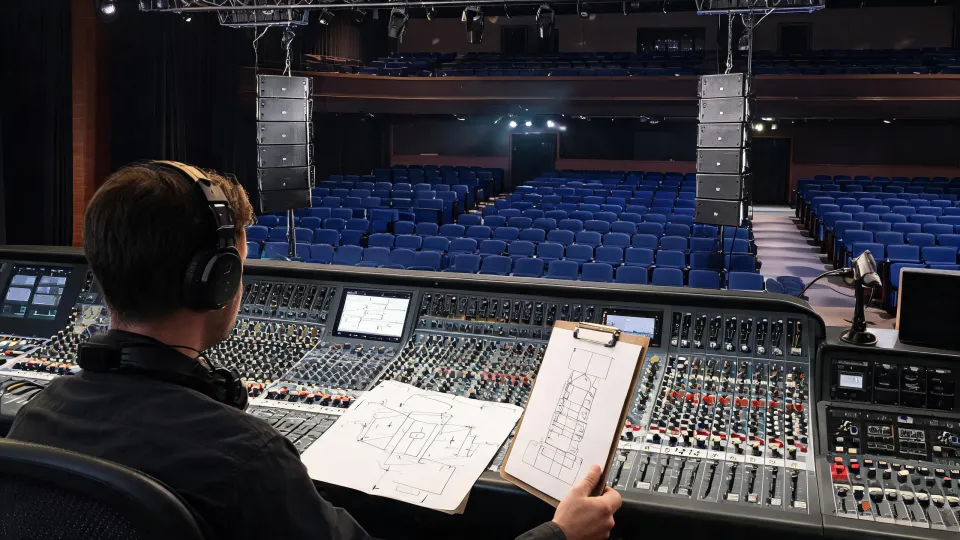
A Martin Audio (martin-audio.com) line array is a beautiful commitment. You don't rent one of those boxes by accident. You book it because you want the low end to feel different and the vocals to stay sharp in a chaotic room. But after twelve years of rescuing events that are about to fall apart, I can tell you the loudest part of your rig isn't the part that decides how people remember you. The signal chain is.
I'm an event audio coordinator. I've handled 40+ rush orders in the last decade, including same-day turnarounds for festivals and corporate launches. My job is triage. When I show up, it's usually because the original plan failed. And more often than not, the failing part isn't the PA. It's the stuff feeding the PA.
Everything I'd read about live sound said the loudspeaker is the star. In practice, I found the star can be killed by the supporting cast.
The Loudspeaker Is Not the Brand
Why do clients insist on a Martin Audio line array? Because the logo carries weight. Sponsors see it on the stage plot and feel more confident. But the audience doesn't check the brand. They check how the keynote sounds, how the drummer's kick cuts through, whether the vows are intelligible at the back of the tent. That's the brand they remember.
I once watched a top-tier line array sound like a phone speaker. The problem wasn't the cabinets. It was a cheap analog mixer with broken gain staging and a microphone that was plugged into the wrong input. The event staff kept blaming the sound system. In my opinion, the sound system was fine. The signal path was not.
The audience doesn't hear the spec sheet. They hear the weakest link.
Amplifiers: The Part Nobody Thinks About Until It Dies
A Martin Audio amplifier isn't just a box with watts. It's the tuning reference for the system. According to Martin Audio's published system documentation, the MLA presets include corrections that assume their amplifier platform. Can you drive a Martin Audio line array with a generic amp? Physically, yes. Predictably? Not really.
In March 2024, a festival called us 36 hours before gates opened. The rented amp that was supposed to drive their MLA hangs had died. The venue offered a 'just as loud' replacement from another brand. My engineer said no. We paid $180 to overnight the correct Martin Audio amplifier, plus $120 in courier fees, on top of the base rental. It was painful. But the client's alternative was walking into a festival with a system that might sound completely different from what they approved.
I've also learned the hard way what happens when you save the small money. At a corporate gala, I used a 'compatible' amplifier instead of the matching one because the rental house gave me a deal. Saved $120. It ran for thirty minutes, then dropped out. We paid $300 for a courier, lost twenty minutes of setup time, and the client almost canceled the following year's contract. Net loss: not just $420 but the trust that makes B2B clients return. That's when we implemented the 'matched amplifier only' policy.
Mixers and Interfaces: The Silent Reputation Killers
This is where I might sound like a snob. I'm not. I own a Maono audio mixer. It sits in my office for quick podcast recordings and voice notes. For that, it's genuinely useful. A Maono audio mixer has its place. The problem is treating every mixer that has an XLR input as a live sound console.
The TC Helicon GoXLR Mini mixer USB audio interface is another example. It's a fantastic tool for streamers. I've used one for a voiceover session, and the routing flexibility is clever. But if you put a live band through it and expect it to hold up against a professional PA, you're asking for trouble. It's not designed for that workload. It will get loud, then it will get messy.
Do I still believe in a rechargeable audio mixer? Yes - actually more than ever. At a mobile product launch last year, the venue's power plan turned out to be two overloaded extension cords. A compact rechargeable audio mixer kept the wireless mic and a phone feed running while we waited for a generator. That small box saved the show. The lesson isn't buy the cheapest mixer. The lesson is to choose the right tool for the input sources you actually have.
Quality Is a System Property
In B2B audio, quality perception is the product. When a client says an event 'felt professional,' they're usually describing the absence of failures: no feedback, no clipped mics, no awkward dead air. Those failures don't often start at the line array. They start in the mixer, the interface, the cable, and the amp rack.
I'd argue that repeat bookings come from consistency. A system with an expensive line array and a weak mixer is capable of great sound for maybe thirty minutes. A balanced system - good loudspeakers, matching amplifiers, appropriate input gear - is predictable. And predictability is what gets you re-booked.
When I stopped letting 'budget but powerful' electronics touch the main stage and put more thought into the signal chain, the notes about harsh highs and muddy lows nearly disappeared. Our repeat booking rate went from 31% to 47% in the following year. That's not because I bought expensive gear. It's because I started using gear that was designed for the job.
But What About the Budget?
I can already hear the procurement person in the back. We don't have the budget to spec a matched amplifier and a premium mixer. I understand. I've been there. The answer isn't to buy the most expensive thing on the shelf. It's to protect the critical path intentionally.
If you're running a small spoken-word event, a rechargeable audio mixer might be the right investment. If you're streaming a product launch from a desktop setup, the TC Helicon GoXLR Mini mixer USB audio interface is a legitimate choice. If you're recording a podcast, a Maono audio mixer will get the job done. Those are all fine. The mistake is putting them in a signal path they were never designed to carry.
Don't spend 90% of your budget on a Martin Audio line array and then feed it through a leftover unbalanced cable. That's not budgeting. That's gambling.
The Bottom Line
So here's my position, and I'm not going to soften it: your Martin Audio line array is a promise. The amplifier and mixer are how you keep it.
The next time you plan a system, ask the same question I ask at every rush order: what happens if this fails? If the answer is 'we'll just turn it up,' that's a risk. If the answer is 'we have the matching amp, the right mixer, and someone who knows how to use them,' that's a brand.
I'd rather be predictable than impressive. In live audio, predictable is impressive. Period.