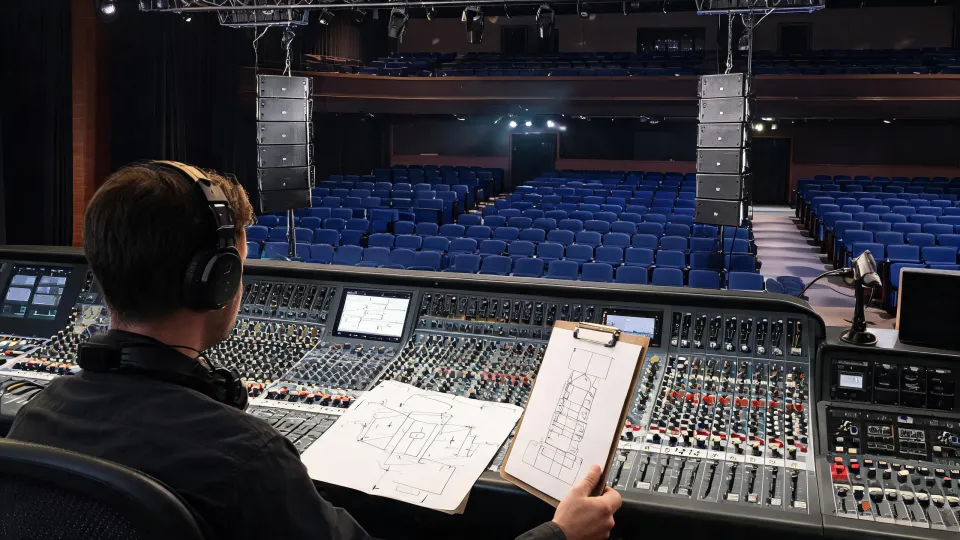
September 2022. A Tuesday. I was sitting in the dark auditorium of a 160-seat community hall, staring at my own patch list like it had personally betrayed me.
The hall's name doesn't matter. The lesson does. I've run a two-person sound design company for nine years, and that night was the low point — not the most expensive mistake I've made, but the one that finally made me start writing things down. Since then, I've documented 14 significant errors, totaling roughly $46,000 in wasted budget. The September 2022 mistake cost me about $1,120 and a full night of my dignity. It could have cost me a client.
The Spec I Was Confident About
The community hall had a drama club, a film society, and a budget of $28,000 to replace a sound system that had been dying in public for six years. The committee hired us because we were small, local, and careful. That last one was about to become questionable.
I specified the loudspeakers first, because that's the part I knew cold. Martin Audio. Not the flashiest name in the rack, but the right pattern control for a room with awful sidewalls. Two W8LC line array elements per side, flown about four meters above the stage, with splay angles set to cover the raked seating. A single compact subwoofer under the stage deck. A Martin Audio DX2 controller in the amp rack to handle EQ, delay, and limiting. Per the published specs on Martin Audio's official site (martin-audio.com), the W8LC delivers 100 degrees of horizontal coverage — enough for every seat in that room without bouncing sound off the plaster walls.
I ordered the W8LCs through a regional distributor. It was a small order by their standards — around $12,000 of loudspeakers and processing — but they didn't treat it like a nuisance. The rep spent an hour on the phone with me, talked through the splay angles, and sent the mechanical drawings for the flying frames. That's the kind of vendor behavior I remember. When you're a small operator, that's the difference between a supplier and a partner.
Then I came to the signal chain. And I made the decision that still shows up in my annual "things I regret" list.
"We'll keep the hall's existing mixer," I told the committee. "It works fine. Saves us $4,000."
I did the math, after a fashion. New mixer: $4,000. Keeping the old one: $0. The upside was $4,000 in savings. The risk was a total failure at the worst possible moment. I weighed both and told myself the risk was theoretical. It wasn't.
What I Didn't Understand About the Mixer
Let me be precise about what "audio mixer meaning" actually is, because I learned it the hard way. A mixer isn't "the volume box." It's the hub of everything: gain structure, routing, monitor sends, broadcast feeds, effects, hearing-assist feeds, and scene changes. In a modern show, the mixer is the brain of the system. The line array is just the voice. Skimp on the brain, and no loudspeaker on earth will save you.
The hall's "existing mixer" was a 1990s-era 16-channel analog desk. It had one broken aux send, a gain knob that crackled if you breathed on it, and zero scene recall. I knew it was old. I told myself it was "adequate." What I failed to ask was: adequate for what? Not for a production. Not for a fundraiser with three acts and a radio broadcast feed. Adequate for one person talking quietly into a microphone, maybe.
Funny side note: a week before the install, the theater manager emailed me a confusing search result — she'd googled "talus z4 audio mixer" and gotten herself turned around. There's no such product. TALUS is a fixed-install loudspeaker series from Martin Audio Limited, not a mixer. The phrase was a collision of two different searches, and at the time, I barely glanced at it. I should have seen it as a sign that the committee didn't fully understand the system. But I was too busy being confident about the W8LCs to worry about the whole picture.
I thought a mixer was a commodity. I thought wrong.
Why DiGiCo Stalked Me That Month
Here's the embarrassing backdrop. Every festival I'd worked that summer had a DiGiCo audio mixer behind the FOH position — usually an SD9 or an SD12. DiGiCo mixers are the touring standard for a reason: 128 input channels, extensive processing, redundant audio engines, scene recall for days. They're magnificent machines for multi-act festivals where one band is tearing down while the next is already soundchecking.
A DiGiCo would have been outrageous overkill for a 160-seat community hall. You could run a small country with what one of those things can process. But here's the thing I got wrong: the gap between "DiGiCo overkill" and "1990s analog desk with one working aux" is enormous. I was so fixated on not being extravagant that I fell all the way down to the bottom. There's a sensible middle — an Allen & Heath SQ, a Yamaha QL, something like that — that would have cost a fraction of a DiGiCo and done everything the hall needed. I never even considered it.
The Night the Board Quit
Opening weekend was a Saturday fundraiser: three acts, speeches, an auction, and a local radio station that wanted a broadcast feed tapped off the mixer. I told the station engineer, "sure, no problem." I had no idea what I was promising.
The band went on first. They asked for a monitor mix. The desk had one working aux send, which I'd already committed to the radio feed. The drama club then needed a separate monitor mix for their one-act play. The film society needed a click track on a dedicated output so it wouldn't leak into the broadcast. None of this was unreasonable. It's what mixers do all over the world, every single night. But it was impossible on that console.
At 8:47 p.m., the aux output started feeding back through the stage monitors at a level that made the lead actress look like she was swatting invisible insects. I muted the aux. The band then told me they couldn't hear anything. Thirty seconds later, one of the main outputs dropped six decibels for no reason I could identify. I was one failure away from a total shutdown, with two hundred people in the room.
I texted a tour-sound friend who happened to be in town. He arrived during intermission, listened to my explanation for about ninety seconds, and laughed.
"You bought the loudspeakers," he said, "and skipped the part every signal passes through."
Then he made a phone call. By 10:15 the next morning, an Allen & Heath SQ-6 and a digital stagebox were in the building, rented for the weekend.
Sunday's matinee went off without a single glitch. The SQ-6 handled the broadcast feed, the click track, two monitor mixes, and a full scene-change cue list. The W8LCs sounded effortless. The committee thanked us warmly. They never knew how close it came to being a real disaster.
The Actual Cost
Let me do the math honestly. The mixer rental was $650 for the weekend. The stagebox was another $180. Cabling, adapters, and a rehearsal evening I hadn't planned for: $120. Plus eight hours of my time at shop rate. Total: roughly $1,120, and that's if you don't charge for the part where I felt like an idiot.
Looking back, I should have spent $4,000 on the right mixer upfront. At the time, it felt like a luxury on a $28,000 budget. It wasn't. It was the cheapest insurance policy that project could have had.
What the W8LCs Taught Me
I don't regret Martin Audio for a second. The W8LCs performed exactly as specified, and they're still in that room today. But they performed exactly as well as the signal I fed them. No better. A loudspeaker is a mirror. It's merciless.
I can only speak to small-throw installation jobs. If you're putting a DiGiCo at FOH with a 12-box MLA system on an outdoor stage, the calculus is different — you're thinking about redundancy, latency, and rider compatibility, not "are there enough aux sends." But the principle is identical: what comes out of the loudspeakers is a perfect reproduction of what you put into the console. Feed it garbage, and it will announce that fact to everyone.
Honestly, I've never fully understood why mixers are the first thing to get value-engineered out of a system design. Speakers get upgraded. Amps get upgraded. But the one device every signal passes through gets treated like a light switch. My best guess is that buyers see a mixer as "just a board" and don't see the hours of routing that live inside it. If any manufacturer figures out how to make mixer capability as visually obvious as SPL specs, they'll own the rental market.
A Checklist That Finally Stuck
My first year in this business (2017), I made a smaller version of the same mistake on a $3,200 order. No mixer in the budget at all. I was sure I'd learned my lesson. I evidently hadn't.
After that weekend, I created a pre-install checklist. It's not glamorous. It's a spreadsheet with a tab for console capability, a tab for aux sends, a tab for input counts, a tab for broadcast and assistive-listening feeds. Every time I think I'm done with a design, I open it and ask the ugly questions: "How many monitor mixes does this event actually need?" "Where does the click track go?" "Who's taking the radio feed?" "What happens when scene two ends and scene three needs different effects routing?"
Since September 2022, that checklist has caught 47 potential errors — including one last month where I was about to hand a client a console with the wrong Dante expansion card. Forty-seven mistakes I didn't have to make. That's forty-seven ways to be publicly wrong that I got to skip.
The small hall, by the way, has referred me twice since. In 2024, the county arts center hired us for a $210,000 theater renovation — the same committee chair's brother sits on their board. The vendors who treated my $12,000 W8LC order seriously back in 2022 are the same people I called for that project. Small doesn't mean unimportant. It means potential.
If you're about to sign off on a system design, do me a favor: look at the mixer first, not last. Understand what an audio mixer actually has to do in this specific room, with these specific users, on their busiest night of the year. And if someone on your team whispers "we'll just keep the old one, it's good enough," remember this: forty-seven is not the number of errors my checklist found. It's the number I let myself walk into. Don't be me.