I handle purchasing for a 40-person production company. That means roughly $180,000 a year goes out across eleven vendors, and I'm the one finance calls when an invoice doesn't match.
When I took over procurement in 2021, I assumed every sound system question had a simple answer. It doesn't. People ask whether they should get the Martin Audio MLA Mini or a passive mixer setup, but that's the wrong question. The useful question is: what's the venue, who's operating it, and how much does a broken day cost? No universal answer exists.
In my experience, the decision splits into three scenarios. I'll walk through each one, then give you a quick way to tell which scenario you're in.
Scenario 1: The system has to leave the warehouse and hit a hard date
This is where the MLA Mini earns its premium. It's a smaller, more portable version of Martin Audio's Multi-cellular Loudspeaker Array line. For a rental company doing live events, a scalable mini line array is a real business tool, not just an expensive badge.
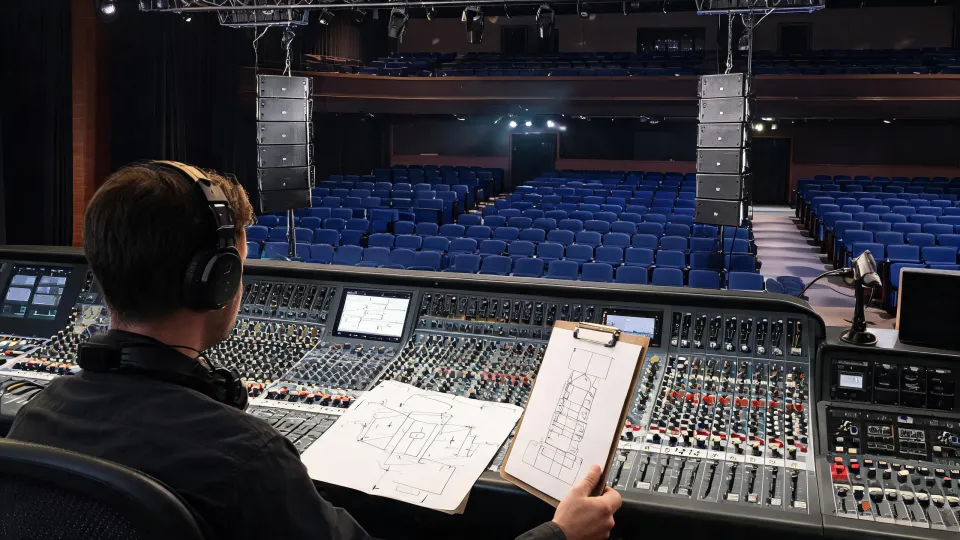
It's tempting to think you can judge MLA Mini on driver size and wattage alone. But the value comes from coverage patterns, rigging angles, and the ability to adapt when the venue changes. Most buyers focus on speaker price and completely miss rigging hardware, flight cases, shipping, and DSP. The first time I priced the full package—including subwoofers, amplifier channels, and cases—our owner laughed. Then a client canceled a point-source system for a 500-person event, and he stopped laughing.
The surprise wasn't the sticker price. It was how fast the array deployed during changeover. Point-source boxes required more positions and more guesswork with dead spots. MLA Mini gave us vertical control and predictable coverage. For a company that pays crew by the hour, that's real money.
Start with the spec sheet on martin-audio.com and compare it against the actual rooms you're hired to serve. You don't buy MLA Mini because it's a line array. You buy it because it solves a coverage problem that point-source systems can't handle easily.
A hard date changes the math. In 2024, we paid $600 for overnight freight on a pair of MLA Mini enclosures. That hurt until I remembered the alternative: missing a $14,000 event contract. When the show date is fixed, "probably on time" is a risk you can't take.
A cheap maybe costs more than an expensive yes.
Because Martin Audio has its roots in London—people still search Martin Audio London to get close to the factory—it's easy to assume a shorter supply chain. In practice, the London engineering history doesn't matter as much as your local distributor's stock levels. Ask for the shipping commitment in writing before you sign a PO.
Scenario 2: The system stays in one room and nobody wants to touch it
For fixed installations, I usually recommend passive loudspeakers, a separate mixer, and a separate amplifier. That feels backwards because the market pushes powered speakers and compact digital mixers. But there's a solid reason.
The term audio mixer passive confuses buyers. It doesn't mean the mixer runs without electricity; it means the mixer has no built-in power amplifier. You connect it to an external amplifier and then to passive loudspeakers. That separation becomes a feature when the system is difficult to access.
If the amplifier fails, you swap an amplifier. If the mixer channel dies, you swap a mixer. If the two functions are combined in one mixer-amplifier, the whole box has to go back to the shop, and the room goes dark. In a venue with a calendar full of bookings, one day of downtime can cost more than the difference between a cheap unit and a service-friendly unit.
That's not theoretical. We lost a room for two days during a client presentation because a small powered mixer failed and the vendor had to ship a replacement from across the country. A refund didn't help. The room was silent, and that was that.
Martin Audio's installation options cover more ground than the MLA lineup. WPS handles outdoor installs, CDD-Live works as a flexible point source, and Blackline is the value end. The goal is to match the coverage pattern to the room, not to force a line array into a fixed install because it looks impressive. In a fixed room, a well-aimed point source often gives you most of the result at half the cost.
If a staff member with no audio training will run the system, keep the controls simple. Put the amp in a locked rack, label the mixer knobs, and write out the two or three presets that are safe.
Scenario 3: You just need one box, a volume knob, and no support calls
There's a whole range of low-stakes spaces where a big system is the wrong answer. A cafe, a workshop, a meeting room, a break room. That's where I recommend the Dayton Audio DA40T tabletop mixer-amplifier.
The DA40T is a small mixer and amplifier in one box. It doesn't promise stadium sound. It doesn't need a rack. It gives a room a few inputs and a volume knob. For a space where nobody is a technician, that's worth more than extra headroom.
Our building manager bought one for a break room. I expected a support call within a week. We never got one. No training, no DSP app, no firmware dance. It sat there and worked.
But the Dayton unit has a clear boundary. If the room is tied to a paid event with a hard deadline, don't build the system around a tabletop consumer product. If silence means a lost contract, you need serviceable gear and a delivery guarantee. The DA40T works when downtime is inconvenient, not catastrophic.
What counts as useful audio mixer news
When you search audio mixer news, you'll mostly see product launches and software announcements. For an admin buyer, that's entertainment, not information. What I actually need to know is three things: certification, warranty, and stock.
Is the mixer certified for electrical safety in the country where it will run? How long is the warranty? Does the vendor have units in stock, or will every replacement need to be ordered overseas? The worst audio mixer news we ever got wasn't a launch; it was a discontinuation notice for a mixer we'd built our spare-parts plan around. Check the lifecycle status before buying multiples of any small mixer.
How to tell which scenario you're in
Three questions will get you most of the way.
- Does the system leave the building? If yes, start with scenario 1. If no, keep reading.
- Does anyone trained operate it? If nobody will touch it, start with scenario 3. If there's a real operator, scenario 2 usually gives more flexibility for the money.
- What does one broken day cost? If a broken day costs more than the equipment difference, buy redundancy, pay for guaranteed delivery, and choose products you don't have to ship abroad for service.
If you're still torn, hire an acoustics consultant for a one-day site visit. It sounds like an unnecessary cost until you watch a $30,000 system fail to cover the room it was bought for. The consultant is cheaper than the return freight.
And once you've chosen a supplier, do the unglamorous admin check: ask for a sample invoice before you place the order. Finance rejected a $2,400 expense for us because the vendor only provided a handwritten receipt. I had to eat that out of the department budget. The gear's reputation won't help you if the paperwork is rejected.
The right choice isn't the brand with the most impressive spec sheet. It's the configuration that fits your dates, your operators, and your tolerance for downtime. Start with the scenario, not the speaker.