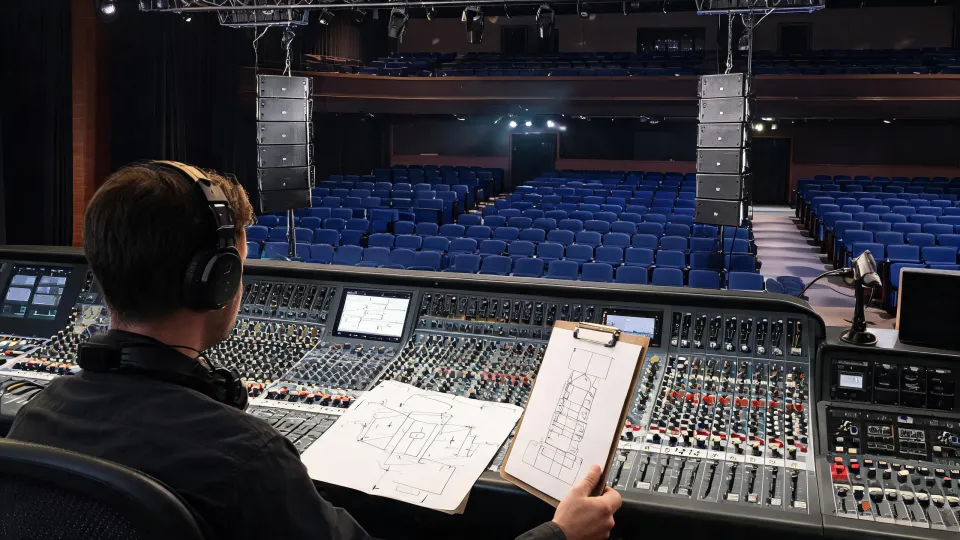
In January 2025, I got the call at 6:40 p.m. A corporate showcase for 300 guests, load-in at 7 a.m., show at 2 p.m. The client didn't know what they needed—they just knew they needed Martin Audio in front of a VIP room.
I'm a systems engineer at a regional production company. I've handled 140+ rush orders in 12 years, including same-day turnarounds for touring bands, DJ showcases, and the occasional event where the original sound company simply didn't show up. This is the context for everything I'm about to say.
Two Martin Audio cabinets keep showing up in those calls: the Martin Audio W8LM compact line array and the Martin Audio X15 stage wedge. This isn't a spec sheet battle. It's a comparison under constraint: which box gets the job done when you're already behind?
Why compare a line array and a wedge at all?
A W8LM is a line array element. An X15 is a floor monitor. They're not direct replacements, and I'm not pretending they are. But when a client calls with one truck and no time, the decision often comes down to these two. According to Martin Audio's product documentation (accessed January 2025, martin-audio.com), the X15 is a two-way stage monitor, while the W8LM is a compact line array element. That official positioning is a good starting point, but in the field the differences show up in ways that aren't on the spec sheet.
Quick disclaimer: I'm not a rigging engineer, so I can't speak to every venue's load ratings or certification requirements. What I can tell you from the systems side is how these boxes behave when you only have one shot.
Coverage: Audience vs. The Band's Feet
If the job is to get sound to 200 seated people, the W8LM is the right tool. Flown properly, a small line array gives you consistent vertical coverage and better level control front-to-back. The X15, by design, is meant to sit at the edge of the stage and point up at a band. It covers the stage, not the balcony.
That's the obvious part. Here's the part that surprised me over time: in a rush, the X15 saves more gigs than the W8LM. Most emergency calls aren't for large format shows. They're for situations where the band can't hear, the DJ booth is in a dead spot, or the keynote speaker needs a monitor. A wedge solves that in five minutes. A mini line array doesn't.
One of my most memorable failures came from ignoring that. I had a client with 500 seats and a slowly dying PA. I knew the room deserved a flown W8LM system, but we didn't have a certified rigger available. I thought, 'What are the odds?' We ran it with a delay ring and wedges. The back half of the room got a muddy mix, and I heard about it for a month. The lesson wasn't 'line arrays are always better.' It was 'don't pretend a wedge is a line array when you have time to fly the real thing.'
Setup speed and failure points
The W8LM demands more of everything: flybars, motors, a processor, amplifiers with the right presets, and a team that knows how to hang it. The X15 needs a speakon cable and a flat surface. In a same-day turnaround, every additional connection point is a risk.
I remember a 2024 outdoor event where the W8LM rig took over an hour to fly because a pickup had the wrong shackles. The X15s on the truck were already producing sound while the line array still wasn't in the air. That's not a knock on Martin Audio—the gear was fine. It's a reality of mechanical rigging: more pieces means more that can go wrong.
Looking back, I should have pushed the client to approve the W8LM earlier in that project. At the time, I was trying to be accommodating. The result was a rushed install and a nervous afternoon. If I could redo that decision, I'd insist on setting up the line array first and fitting the rest of the show around it.
The mixing chain: headphones, portable mixers, and Frank Serafine
Now for the part that doesn't show up in speaker marketing: the audio mixer headphones in my bag and the portable audio mixer I treat as a survival tool. When I'm doing a rush gig, I don't assume the venue's console will make sense. I bring my own portable audio mixer and a pair of closed-back audio mixer headphones, and I check every input before the PA is even connected.
Frank Serafine's work on Tron is the classic example. The portable audio mixer Frank Serafine used during those Tron sessions wasn't flashy, but it let him capture sounds wherever the window existed. If that sounds like the 'portable audio mixer Frank Serafine Tron' story to you, you already know the value of being able to listen anywhere.
If you're mixing a DJ event, the source might be a deej audio mixer with a different output level than a live console. A deej audio mixer can push a surprisingly hot master signal, and if you feed that into a W8LM without padding, you'll get distortion on the first drop. That's a client perception killer.
Reliability and client perception
Both of these cabinets are workhorses. But the W8LM has more potential points of failure: the rigging, the processor, the interconnects, the amp settings. The X15 is almost boring in the best way. It goes in the truck, comes out, takes a beating, and works.
This is where quality perception enters. Clients don't know the difference between a line array and a wedge. They know whether the first note hit them in the chest or sounded like a phone speaker. I've watched a client walk past a cheap plastic speaker and stop to comment on a Martin Audio wedge—not because they knew the model, but because it looked and sounded confident. The detail is the brand.
In my experience, the $50 difference between a generic stage monitor and a Martin Audio X15 is nothing compared to the cost of a lost repeat client. I've called for a same-day replacement at $800 in rush fees and saved a $12,000 project. Quality is not an add-on. It's the thing the client remembers.
Which one goes on the truck?
My experience here is based on 140+ rush orders in the regional touring and corporate segment. If you're working on a stadium tour or a permanent installation, your experience might differ—and the balance shifts toward MLA or a full W8LM system because you have the crew and time to do it right. For the rest of us, here's my rule:
- Take the Martin Audio W8LM when the room has 150+ people, you have four hours or more on site, and you've got the rigging hardware and someone qualified to use it.
- Take the Martin Audio X15 when the deadline is brutal, the stage needs monitors, or the show is small enough that a point-source wedge can do the job.
- In both cases, pack a portable audio mixer and good audio mixer headphones. Frank Serafine would understand.
I don't believe in 'always choose A' answers. The right answer depends on how much time you have, how many hands are available, and what the client's actual ears need. W8LM when you can fly it right. X15 when the clock is the real boss.
And if you're reading this because you just took a rush order for tomorrow morning—check the rigging first, then the mixer, then the headphones. The speakers will be fine.