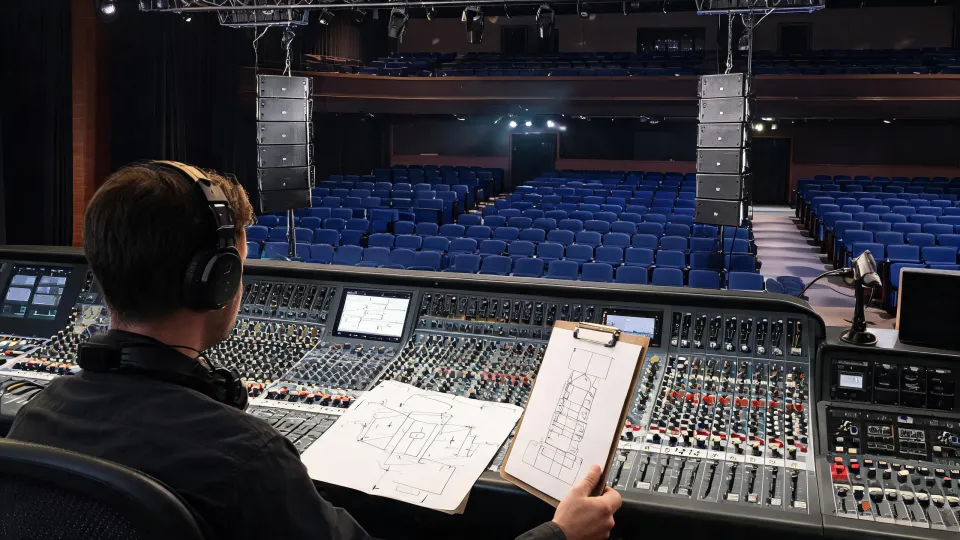
-
1. What's the most expensive Martin Audio line array mistake you've made?
-
2. Is Martin Audio subwoofer phase alignment really that important?
-
3. Do I actually need a studio mixer for a Martin Audio setup?
-
4. Is original Martin Audio rigging really worth the extra cost?
-
5. CDD-Live or WPS for a mid-size venue?
-
6. What's the one check nobody does before a gig?
-
7. What's your final advice for buying a Martin Audio system?
Eight years. Fourteen documented mistakes. Roughly $28,000 in wasted budget. I've configured Martin Audio systems for live sound and fixed installation long enough to know exactly which corners cost the most to cut. This FAQ is the one I wish I'd had before my first Martin Audio line array hang. No fluff, just answers — including the ones I learned the hard way.
What this FAQ covers:
- The most expensive line array mistake I made
- Why subwoofer phase alignment is non-negotiable
- Do you need a studio mixer for live sound?
- The true cost of cheap rigging
- CDD-Live vs WPS: how we chose
- The DSP preset check nobody runs
- Final advice before you buy
1. What's the most expensive Martin Audio line array mistake you've made?
In my first year of doing line array work (2017), I trusted the prediction software a little too much. The angles looked right, the SPL map looked right, everything looked right. Then the room behaved differently. I'd set the array angles based only on the rear-field coverage and completely ignored the near-field. The front rows couldn't hear the vocals clearly, and the balcony got hammered with high end.
The client didn't complain at first. They just never booked us again. That silent loss hurt more than any invoice ever could.
Now, every Martin Audio line array deployment starts with two checks: the prediction model and a physical near-field walk-through. The software tells you the array can do it. The walk-through tells you what the audience will actually hear. Both matter. I learned that mistake's cost the hard way — roughly $8,000 in rebuild labor plus a relationship damaged beyond repair. Simple.
2. Is Martin Audio subwoofer phase alignment really that important?
Yes. Full stop. In September 2022, I had a Martin Audio subwoofer system that measured beautifully on paper. All drivers passed polarity tests, and the tuning curve looked clean. But when we hit the intro of the first song, the low end just vanished. Not reduced — gone. The main array and the subs were fighting each other because their phase alignment at the crossover point was wrong for the listening area.
I wouldn't have believed it possible if I hadn't watched it happen on a spectrum analyzer while the audience sat there looking confused. That gig was a $3,200 order, and the promoter asked for a refund. We eventually fixed it, but the embarrassment stayed.
The fix is boring and free: measure phase alignment at the crossover, not just polarity. It takes five minutes with the right tool. It's non-negotiable in my checklist now. Period.
3. Do I actually need a studio mixer for a Martin Audio setup?
A question that comes up constantly in my world is whether a mixer audio studio is a good investment for live sound. It depends on your workflow. Live shows with a Martin Audio line array need a low-latency digital console with proper routing, scene recall, and — critically — the ability to change settings fast without losing your mix.
A studio mixer, on the other hand, is built for a different workflow. Some engineers want to record shows or build virtual soundchecks. For that, you're often better off with an audio interface than a studio console. The Focusrite Scarlett series is a common choice (and a lot of people call it a 'scarlett audio mixer,' even though it's technically an audio interface — it works great for capturing multitrack, but I wouldn't run a live show on it).
One unexpected cheap tool: a free audio mixer app. Many modern digital consoles allow wireless control, and having an audio mixer app free on a tablet saved a show last year when the console's surface locked up mid-set. Not elegant, but functional.
Here's the thing: don't buy a "studio mixer" for a touring PA. Define your actual need first.
4. Is original Martin Audio rigging really worth the extra cost?
I'm going to tell you a story that makes me wince. I tried to save $300 on rigging hardware for a Martin Audio line array by ordering a "compatible" set from a third-party supplier. The pins were slightly underspecified for the MLA Mini's locking mechanism, the load documentation was unclear, and the whole thing didn't fit properly when we got to the venue. $300 saved became $1,800 spent on replacement parts, four days of delays, and a very suspicious crew.
That's when I learned my current rule: rigging is part of the loudspeaker system, not an accessory you can cheap out on. The original Martin Audio hardware isn't just about certification — it's about fit, finish, and consistency. And clients notice. When a system looks clean and goes together without filing and cursing, they perceive it as more professional. That perception matters for your brand. The $300 saved cost me $1,800 plus credibility — a poor trade.
5. CDD-Live or WPS for a mid-size venue?
CDD-Live was the right choice for us, but our situation was a 1,200-capacity multipurpose hall with predictable sightlines and good acoustic treatment. If you're dealing with outdoor festivals or highly reflective industrial spaces, the calculus might be different.
In our context, CDD-Live's concentric diffuser gave us excellent consistency across the room at relatively short throw distances. The WPS series, by contrast, is built for higher-SPL touring applications where you need more punch and projection across a longer throw.
My experience is based on roughly 200 installations in the 500-to-2,000-capacity range. Larger open-air stages probably involve factors I'm not aware of. And when comparing specs, remember that sensitivity numbers are measured at 1W/1m per AES2-2012 (revised 2020) — so check the conditions behind the data. Martin Audio's product pages (accessed January 2025) are a reliable starting point for coverage angles and SPL ratings.
6. What's the one check nobody does before a gig?
Checking the DSP presets. Really. In Q1 2024, I created our team's pre-check list after a show in which the low-mid response was inexplicably weak. We swapped cables, changed inputs, verified the board routing, and found nothing. The problem was the high-pass filter left over from the previous event still sitting on every output channel.
Sixteen months later, that checklist has caught 47 potential errors. The most common: DSP settings from the last show that were never reset. The second most common: a polarity error in a subwoofer array. The list takes 20 minutes, and it has saved us from at least a dozen embarrassing moments.
Check the presets. Every time. That's it. Done.
7. What's your final advice for buying a Martin Audio system?
Do the prediction. Run the phase check. Buy the right rigging. Measure the room before you spend money on a Martin Audio line array, and treat every show as a fresh start rather than assuming yesterday's settings still work.
A Martin Audio subwoofer and line array are tools. Used correctly, they deliver the kind of sound quality that defines a professional operation. Used carelessly, they expose every shortcut you tried to take — usually at the worst moment, in front of the most important client.
I've got the invoices to prove it (unfortunately).