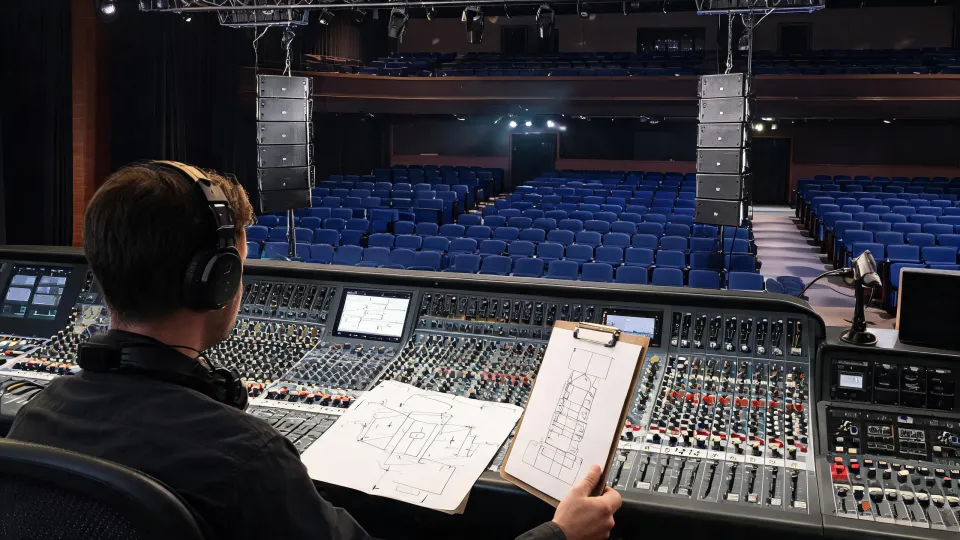
Here's the short version: for an emergency event PA I spec a pair of Martin Audio CDD10s over an SX110 subwoofer, and I don't load them on the truck until they've passed a loudspeaker audio test. The rig looks fine on a spec sheet, but a spec sheet doesn't buzz, rattle, or go quiet at the wrong moment. The 15 minutes of testing before the gig are worth more than any brand name on the box.
I'm a production manager for an event production company. In the last three seasons, our team has handled over 200 rush orders, including a March 2024 product launch booked 36 hours out. That job was CDD10s, an SX110, a rechargeable audio mixer, and a Mac running live audio mixer software. It worked because the gear was tested before it was in front of the client.
I went back and forth between the CDD10 and the CDD12 for a while. The CDD12 gives more output, but for a 150-person event the CDD10 is enough, and it's lighter. The SX110 is the compact sub that takes the low-end load off the CDD10s. Together they fit in a van with one amplifier and a small mixer. That matters when the clock is running.
Martin Audio's SX110 subwoofer specifications on martin-audio.com list a 10-inch driver in a vented enclosure, designed for applications where a full-size sub is overkill. It does not produce the kind of bass that shakes a 1,000-seat hall. It does produce the kind of bass that makes speech and acoustic music feel full. If you know a client is going to expect chest-thumping kick drum, bring a bigger sub or two SX110s.
Check the current spec PDF before you quote exact numbers; my point isn't to replace that sheet, it's to tell you what the sheet doesn't tell you: how the rig behaves under a deadline.
Loudspeaker Audio Testing: The 15-Minute Check
Here's the thing: a lot of what we call 'speaker failure' is actually connection failure. In six years of rush orders, I can count more issues caused by bad speakON pins and flaky cables than by drivers that died on their own. Testing catches those before the client does.
1. Cable and connection test
Check the speakON connectors lock. Pull on them. A cable that clicks in but wiggles free is a risk. If you have a cable tester, use it. I used to skip this because it felt slow. Then a loose NL4 cost us a full rehearsal while a cleaner traced the fault. Not ideal, but workable after the fix. Now I don't skip it.
2. Impedance test
With the amplifier off, set your multimeter to ohms and read the speaker from the end of the cable. An 8-ohm CDD10 usually reads around 6 to 7 ohms because of the voice coil. A dead-short near zero or an open line near infinite means you've found the problem before it found you. I've seen a speaker with a partially damaged voice coil pass a visual check but read almost 15 ohms. The test is what flagged it.
3. Acoustic test
Now comes the part people want to skip. Give the system power, turn the mixer output down, and route a sine sweep from 50 Hz to 20 kHz through the amplifier. Walk around the PA. Listen for buzzes, rattles, or a driver that drops out halfway. I use a Mac with room-measurement software for this. It doesn't need to be a $5,000 measurement rig; it needs to be consistent.
One counterintuitive thing: test at low level first. At high SPL, a loose screw or grille rattle can be masked by the noise. At low level, the buzz is easier to locate. A speaker that buzzes at low level won't fix itself at high level.
4. Polarity test
Use a polarity tester, or if you're comfortable, a 1.5V battery across the speakON pins to see the woofer cone. The cones should move the same direction in all drivers. If one subwoofer pushes out while the other pulls in, you have a swapped wire and no amount of EQ will bring the bass back. A polarity test stops that before the first downbeat.
Why do I put a rechargeable audio mixer in the emergency kit? Because our loading dock doesn't always have power. A battery-powered mixer with a USB audio interface turns that dock into a test bench. I connect my Mac, launch the live audio mixer software and a measurement app, and run the sweep without hunting for an outlet. The same mixer doubles as a backup console for a small event. It's not a 48-channel board, but it's better than silence.
I'm always surprised how many techs leave the laptop in the case. If you're already carrying a Mac, load it with live audio mixer software and a simple RTA. You can check routing, levels, and speaker behavior before a sound check. A laptop does not replace ears, but it catches what ears miss.
Last season, on a same-day setup, one of the SX110 pair lost output during the sweep. Turned out the installed speakON wiring had a cold solder joint; the impedance test showed it right away. We fixed it, and the client's speech went off without a problem. Dodged a bullet, and the bullet had a name: skipped testing.
According to Martin Audio's official product documentation, always check the current SX110 subwoofer specifications before installation because cabinets and drive units can change between production runs. The spec sheet is the baseline, but our own test is the contract.
We also have a rule about claims: we only promise what we can prove. That's not just customer service. Under FTC advertising guidance, a claim about a product's performance should be truthful and substantiated. If we tell a client the rig is 'ready to go,' we need a test that makes that claim real.
When This Rig Is the Wrong Answer
If the gig is a 1,000-capacity outdoor stage, the CDD10/SX110 combo is not the main PA. Use it as fill or delay, but not as the headline system. If the event is a full-band rock show with heavy low end, you need a bigger sub. And if the client asks for 'full coverage for any venue size,' don't say yes. Say what this rig can do and what it can't. The trust is worth more than the paycheck.
Also, a rechargeable audio mixer is a backup tool, not a substitute for a proper console when you're mixing 24 inputs and 8 monitor mixes. Choose the right tool for the event.
The final thought I want to leave you with is not about Martin Audio, CDD10, or SX110 specifically. It's about the habit. Pick a rig you trust, test it every time, and charge the backup mixer. The deadline will be a lot less scary.